Seasons
Kamakura hydrangea season 2027: dates, Hasedera tickets and a temple route
This page contains affiliate links. Booking through them costs you nothing extra and supports the site. Details.
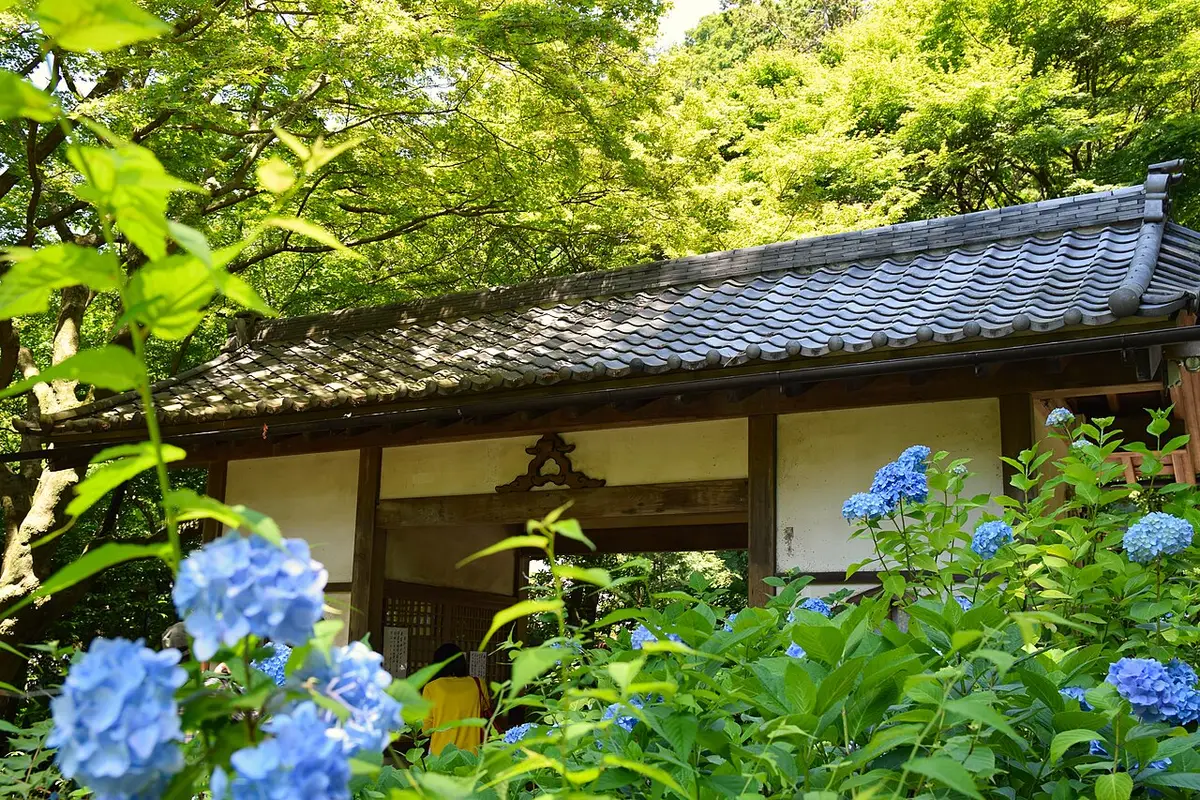
Table of contents
- When the hydrangeas bloom in 2027
- Hasedera’s hydrangea path tickets
- Hydrangea temples in Kita-Kamakura
- Hydrangeas in Hase and along the Enoden
- A hydrangea day in Kamakura: weekday and weekend order
- How early to arrive
- Where to stay the night before
- Tours in hydrangea season
- Practical: getting there, cost and what to bring
Kamakura’s hydrangea season runs through June, and the 2027 peak is most likely in the middle two weeks of the month. The two names everyone wants are Meigetsu-in in Kita-Kamakura, a narrow approach lined with about 2,500 shrubs, and Hasedera in Hase, a hillside path of more than 40 varieties above the sea that needs a timed ¥500 ticket at peak. They sit at opposite ends of town, each about an hour from Tokyo by train. The one decision: which of the two you see at opening time, and which you book a slot for. This page gives the dated 2027 window, the ticket rules, every garden worth a stop and two timed routes.
When the hydrangeas bloom in 2027
The window below is the first-bloom date of the Japan Meteorological Agency’s reference hydrangea at the Yokohama observatory over the last 20 years. These are Yokohama observatory dates, not Kamakura peak dates.
The 2027 median is June 11, with a likely range of June 3 to June 17. The 1991 to 2020 normal is June 12. In 2026 the Yokohama shrub opened on May 28, the earliest date in the 20-year window and 14 days before the median, so an early year is possible.
First bloom is not peak. The JMA date marks the day the first flowers open on one shrub. Kamakura’s temple gardens hold dozens of varieties that open over several weeks, and the gardens fill out over the weeks around that date. The Kamakura City Tourism Association puts it plainly: yama-ajisai and gaku-ajisai open from late May, and the large Western hydrangeas peak from early to late June.
Here is how Hasedera’s own bloom reports lined up with the Yokohama date in recent years:
| Year | Yokohama first bloom | Hasedera hydrangea path, as the temple reported it |
|---|---|---|
| 2023 | June 7 | about 40% open on May 29; about 70% and at its best on June 7; past peak by June 26 |
| 2024 | June 10 | 50% on June 2; full bloom June 10; still at its best June 17; past peak by June 24 |
| 2025 | June 16 | about 20% on May 28; 50% on June 4; paid period June 6 to June 26 |
| 2026 | May 28 | colour deepening May 28; at its best June 11; late varieties opening June 19; nearly over June 26 |
Two things stand out. Hasedera’s best weeks moved much less than the Yokohama date did, and June 10 to June 17 fell inside Hasedera’s peak in all four years. Sources: Hasedera’s flower posts for 2023, 2024, 2025 and 2026.
Meigetsu-in can run earlier. On May 28, 2026, the tourism association reported its hydrangeas already at their best with about ten more days of peak expected, and on June 11 it was at full peak. If your dates are fixed in early June, Meigetsu-in and the yama-ajisai gardens are the safer bet; for mid-June, everything is in play. The bloom calendar shows the hydrangea window next to cherry and autumn leaves, and best time to visit covers June’s weather and crowds.
Hasedera’s hydrangea path tickets
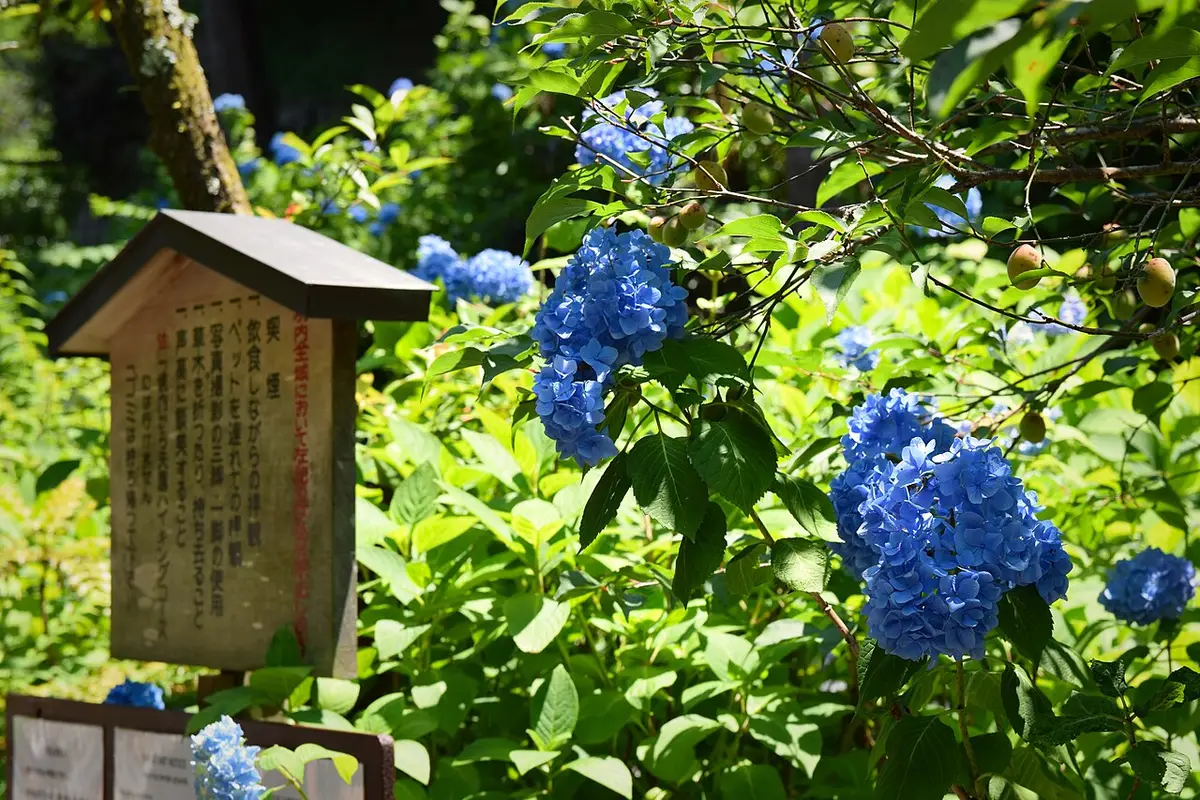
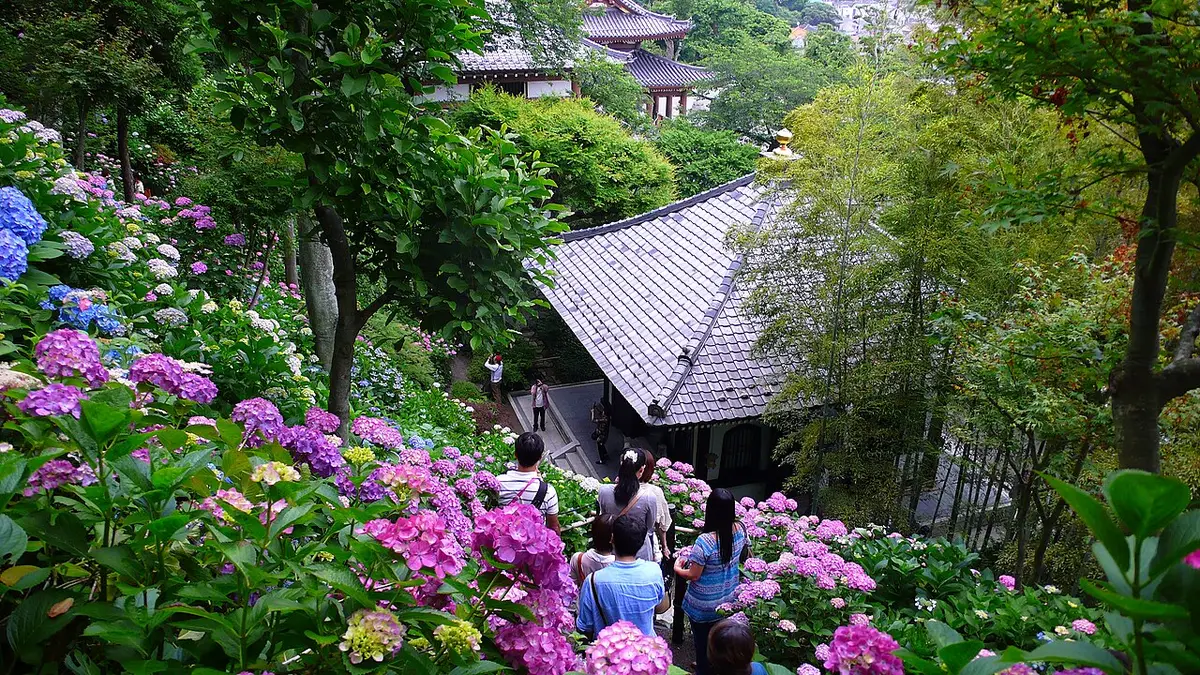
Hasedera’s hydrangea path climbs the hillside above the main hall, with more than 40 varieties and about 2,500 plants and a view over Yuigahama. At peak the path gets very crowded, so the temple controls entry with a timed ticket. The rules below are the 2026 rules as Hasedera published them in its hydrangea path notice and its May 2026 press release. The temple announces the year’s paid period on hasedera.jp once the bloom reaches about half, so expect the 2027 version in late May or early June.
What you pay. Temple admission is ¥400 for adults and ¥200 for children, paid at the gate on the day. On top, during the paid period, the hydrangea ticket (ajisai-ken) costs ¥500 for everyone of elementary school age and up. You need admission even if you booked the hydrangea ticket online; admission cannot be booked.
When the ticket applies. From about 50% bloom until the peak has passed. In 2024 that was June 1 to June 23, in 2025 June 6 to June 26, and in 2026 it started on June 5. Before and after, the path is open with admission only.
How online booking worked in 2026.
- Booking opened every Tuesday at 10:00 for the seven days from that weekend. For June 6 to June 12, 2026, it opened on Tuesday, June 2.
- Up to 10 tickets per booking, so one person can book for a group.
- Each ticket has a 60-minute entry window. The first window in 2026 was 8:00 to 9:00, then 8:10 to 9:10, 8:30 to 9:30 and so on, with the last window 15:50 to 16:50.
- You cannot enter before your window. If you are late, you wait in the grounds until staff let you in.
- Online tickets can be cancelled until the day before, not on the day.
In 2024 and 2025 booking opened on Thursdays instead, and in 2024 the cap was 4 tickets per booking with the first window at 9:00. Check the day of the week again in May 2027.
Day tickets. Pay admission at the gate, then buy a hydrangea ticket at the sales point by the path entrance. You choose a time, but numbers are limited and early windows can be gone. If your window is hours away you may leave the temple and come back; show both tickets on re-entry. Same-day tickets are not refundable.
Before you go. The path starts after about 80 steps and has about 130 more, with no slope, so it is not suitable for wheelchairs or strollers. Hasedera links a live crowd page from its home page. Unapproved live streaming is not allowed on the path.
Outside the paid period there is no hydrangea ticket, but the path can still fill up. When it does, staff hand out numbered entry tickets (seiriken) and let people in by number, as Hasedera described it in late June 2023 after the peak had passed.
Hydrangea temples in Kita-Kamakura
Kita-Kamakura is the valley one JR stop north of Kamakura, 53 minutes from Tokyo Station (¥902 by IC card). Meigetsu-in, Tokeiji and Engakuji are all within a short walk of the station, so the area works as a morning on its own. The Kita-Kamakura guide covers the other Zen temples on the same road.
Meigetsu-in
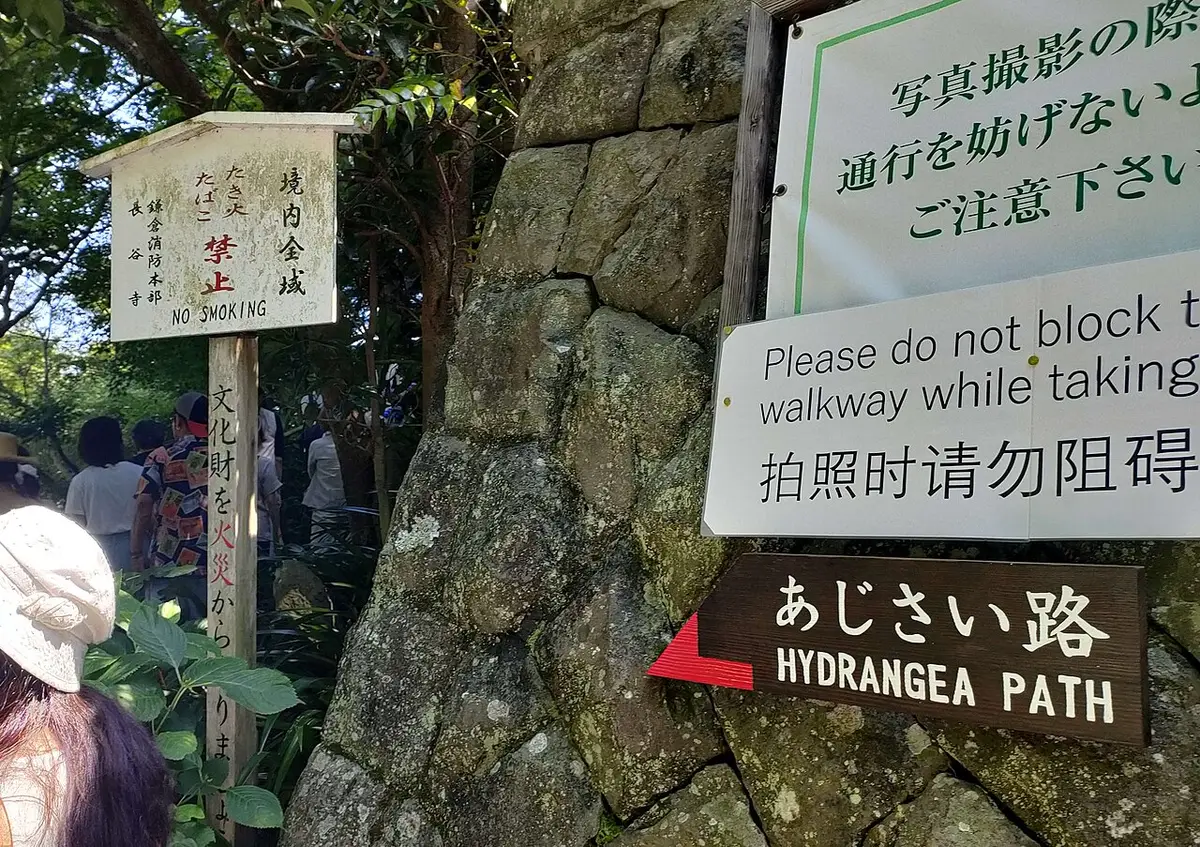
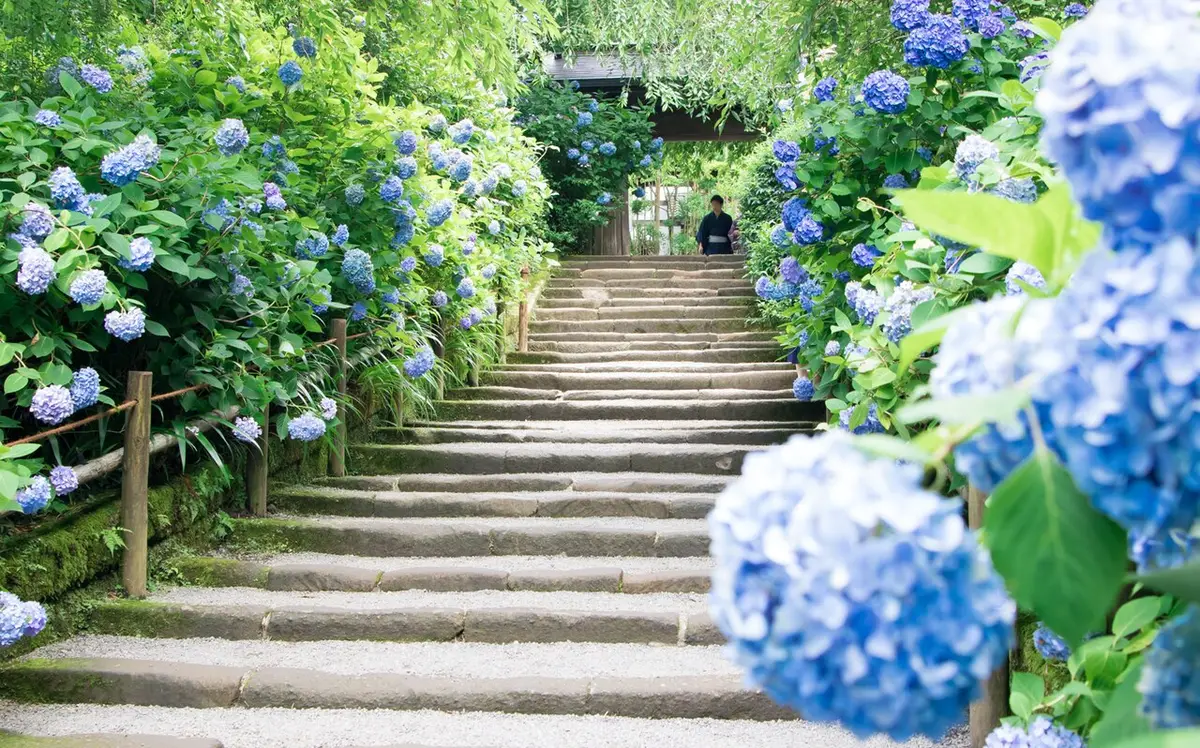
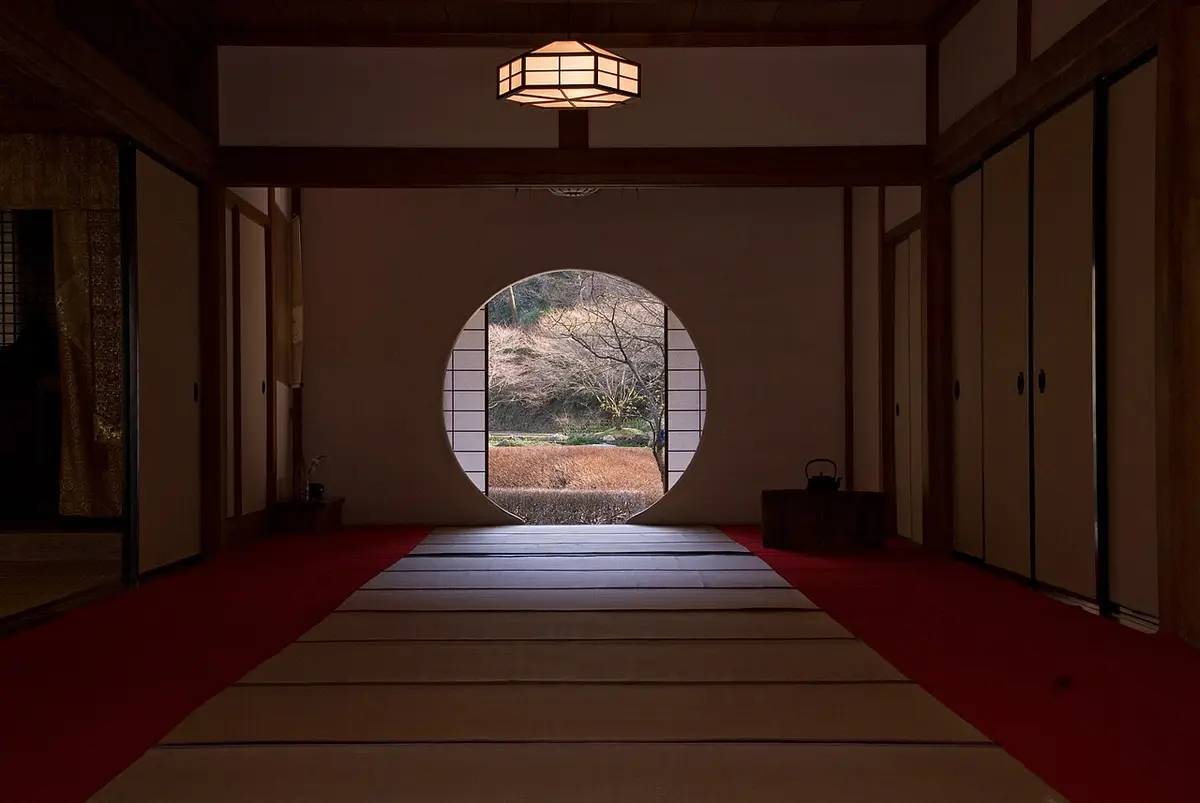
Meigetsu-in is the temple people mean by “the hydrangea temple”. About 2,500 shrubs line the stone approach, most of them one shade of blue, and the effect is a corridor of flowers rather than a garden you walk around. The hydrangeas are a post-war addition, planted in place of the posts that would normally edge the path. In June the temple opens earlier: 8:30 to 17:00 with last entry at 16:30 in 2026, against 9:00 to 16:00 the rest of the year. The round window in the main hall stays viewable in season, and the rear garden behind it opens for an extra ¥500 when the irises flower (tourism association listing). The Meigetsu-in guide has the window, the rear garden and the queue in detail. To be inside before the crowd, a Zen temples private tour can start here with a licensed guide.
Fee ¥500 (child ¥300)June hours 8:30-17:00, last entry 16:30Rear garden ¥500 extraFrom Kita-Kamakura Stn 10 min walkMapOfficial site
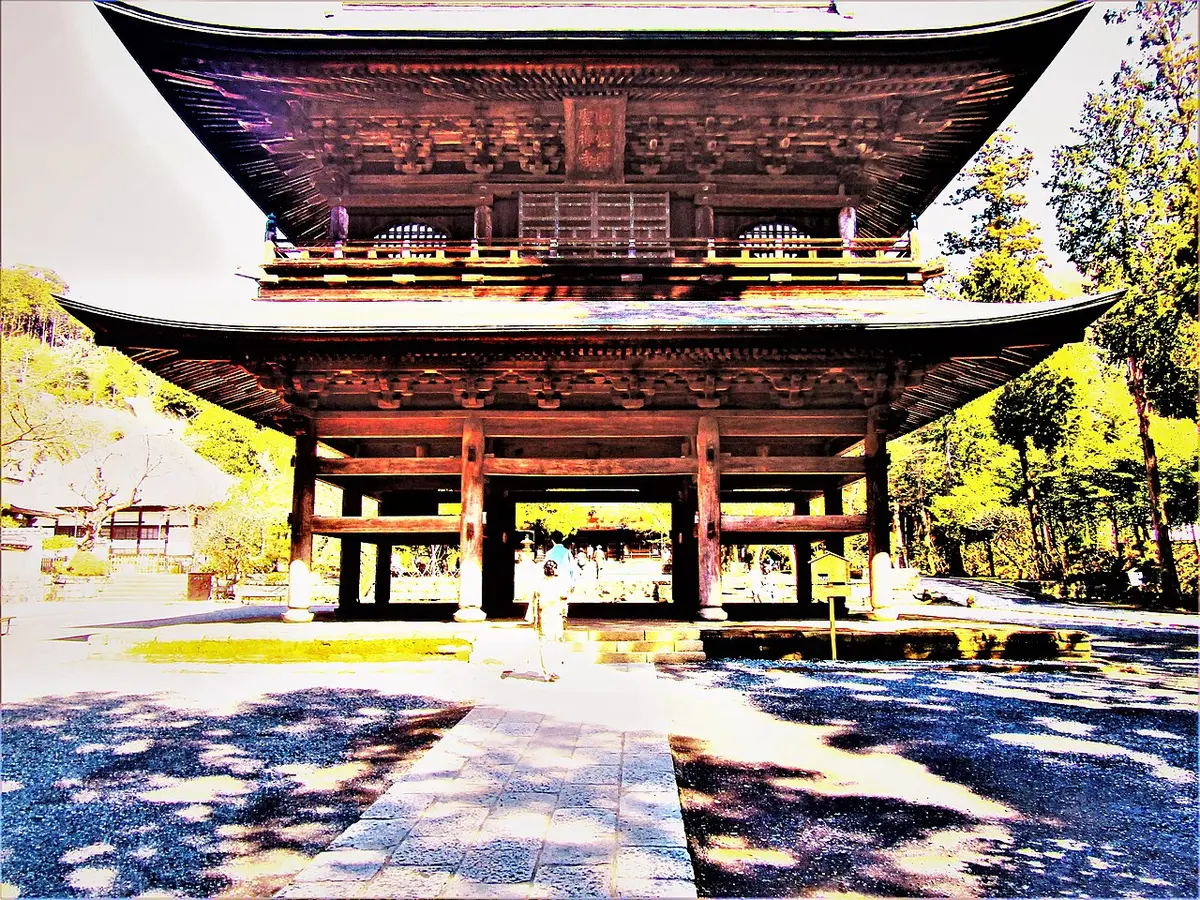
Engakuji
Engakuji is the large Zen complex directly opposite Kita-Kamakura Station, founded in 1282. It is not a hydrangea temple in the way Meigetsu-in is, but its grounds are a calm counterweight: in June 2026 the tourism association reported hydrangeas mainly along the path on the right as you walk up, and a display of hydrangea glass balls on the veranda of the Daihojo hall that was planned to stay until about July 10. It opens at 8:30 (hours and fees), which makes it the natural first or last stop of a Kita-Kamakura morning. Because it is one minute from the station, it also works well while you wait for a later train. A half-day walk of Zen temples and the Great Buddha starts here and ends in Hase.
Fee ¥500 (child ¥200)Hours 8:30-16:30From Kita-Kamakura Stn 1 min walkMapOfficial site
Tokeiji
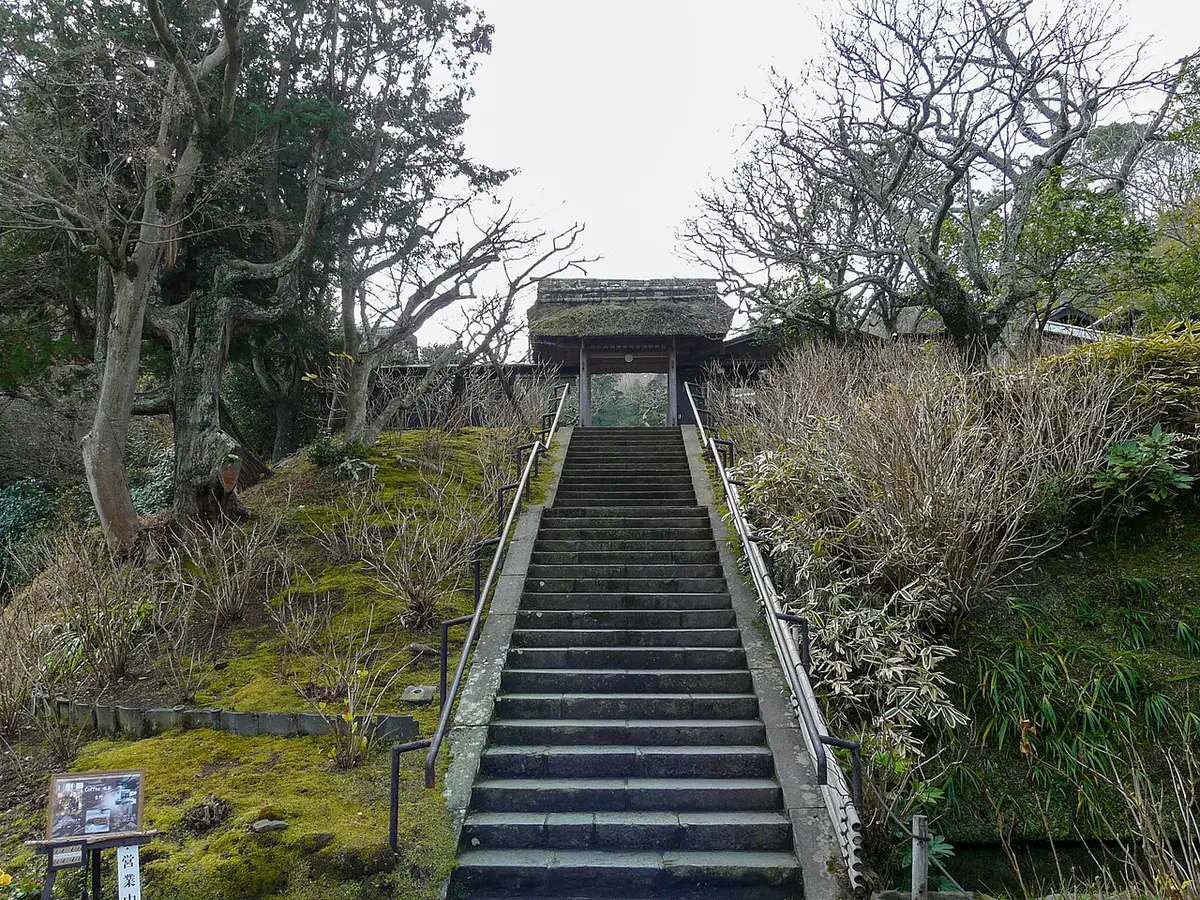
Tokeiji, founded in 1285 and for about 600 years a refuge temple for women seeking divorce, is four minutes from Kita-Kamakura Station. It charges no admission (the temple asks you to pray at the main hall and leave an offering) and opens 9:00 to 16:00. In June its garden has irises and iwagarami, a climbing relative of the hydrangea. The rule that matters: since June 2022 visitors may not take photos anywhere in the grounds, with a camera or a phone (the temple’s notice). That makes it a calm stop and a good place to slow down between Meigetsu-in and Engakuji. The treasure house is closed on the first and third Tuesday of the month.
Fee none (offering)Hours 9:00-16:00Photos not allowedFrom Kita-Kamakura Stn 4 min walkMapOfficial site
Hydrangeas in Hase and along the Enoden
Hase is four minutes from Kamakura Station on the Enoden (¥200), and the next stop west, Gokurakuji, is one more minute. Hasedera, the Great Buddha and three smaller hydrangea spots are all within walking distance of each other. The Enoden guide covers fares, passes and how often trains run.
Hasedera
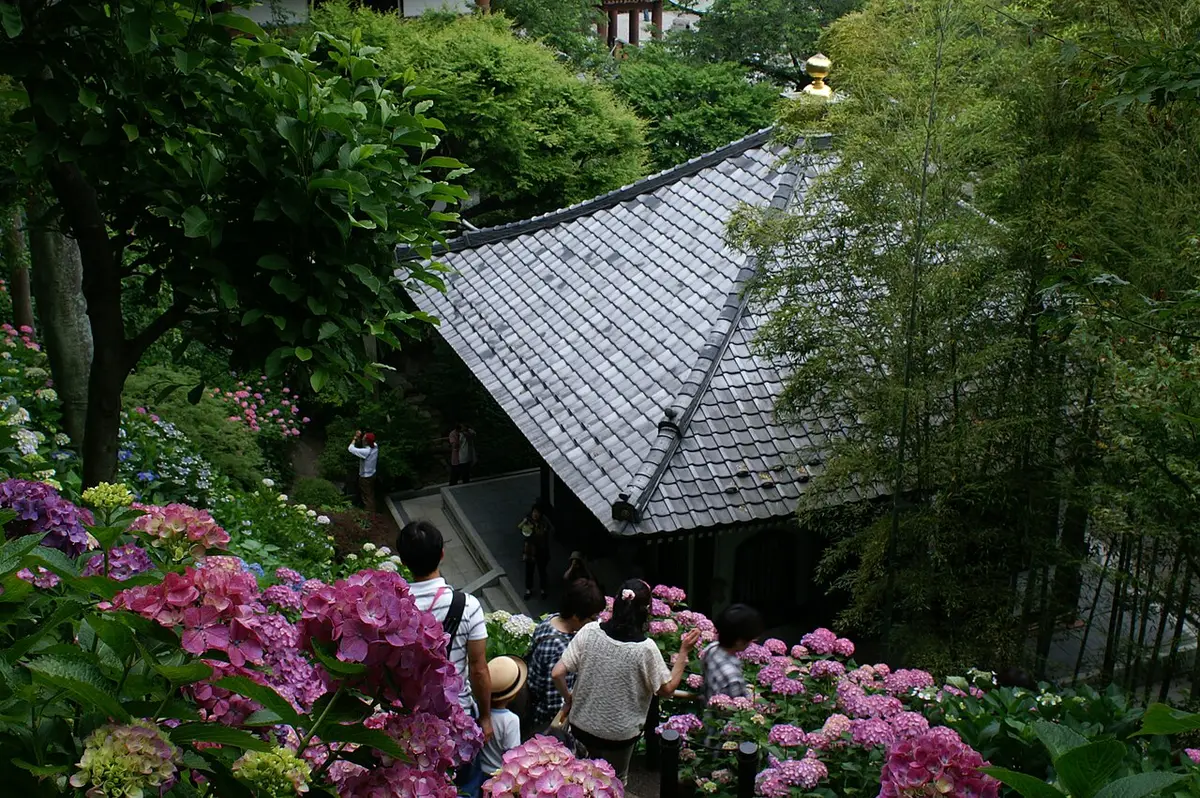
Hasedera is the other half of Kamakura’s hydrangea pair, and the reason to book ahead. The hydrangea path runs up the slope above the Kannon-do hall, and from the top you look over Yuigahama and the bay. Beyond the path the lower precinct shows potted early varieties, including hydrangeas the temple has named itself, such as Hase no Inori and Hase no Shiosai, so even without a hydrangea ticket you see flowers. The temple opens at 8:00 and in June stays open until 17:30, with last entry at 17:00. Hasedera’s own flower posts report bloom progress through the season. For a guided version, the early-bird morning tour starts with Hasedera before the crowds and keeps groups to eight.
Fee ¥400 (child ¥200)Hydrangea ticket ¥500 in seasonJune hours 8:00-17:30, last entry 17:00From Hase Stn 5 min walkMapOfficial site
Goryo Shrine and the Enoden crossing
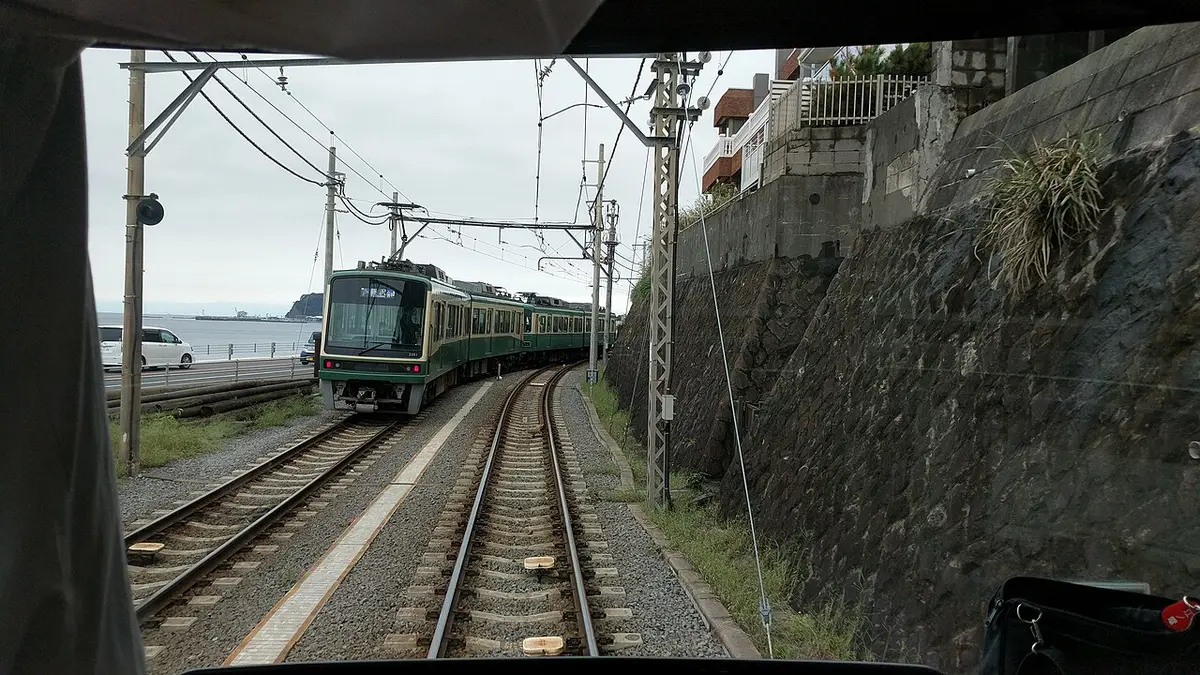
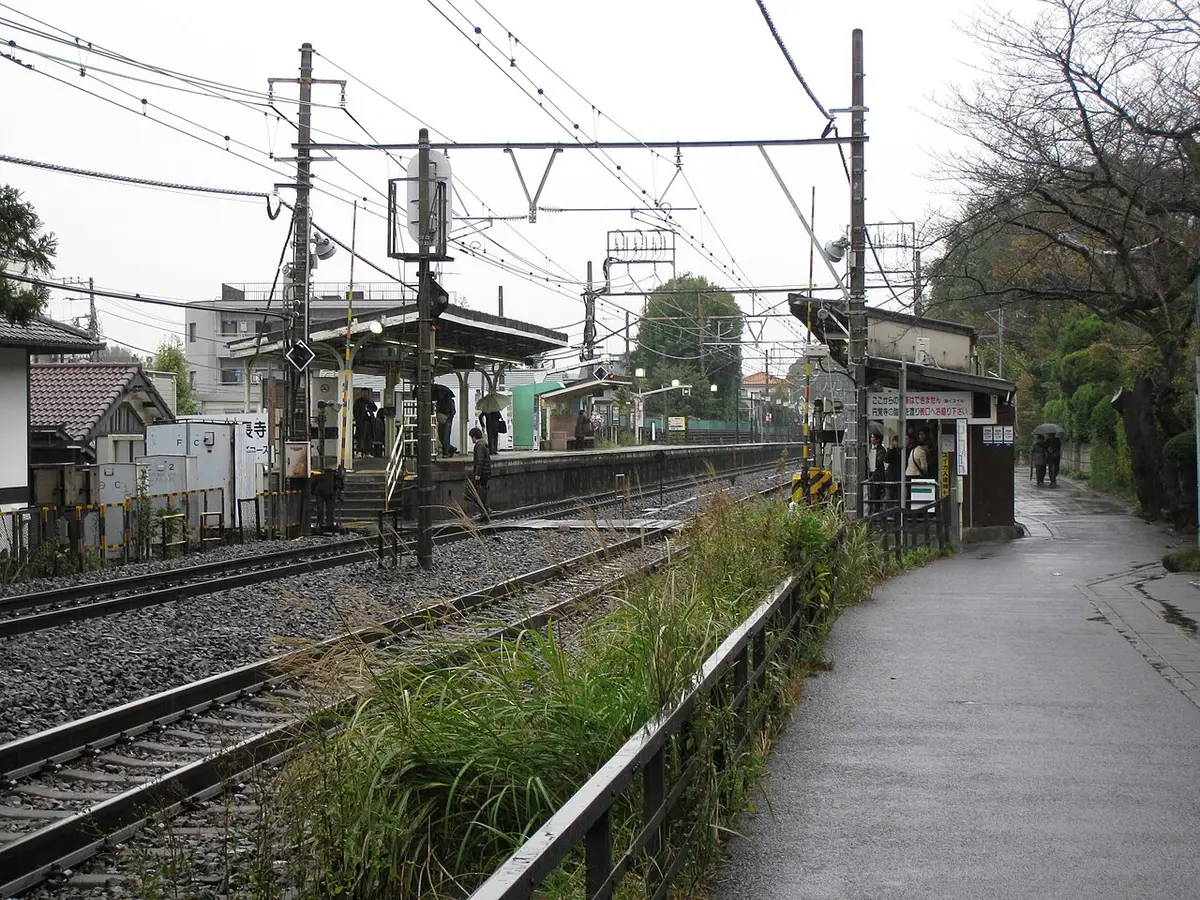
Goryo Shrine in Sakanoshita stands right beside the Enoden: the line crosses the approach at the foot of its torii, so trains pass a few metres from the shrine’s hydrangeas. The grounds have plenty of hydrangeas of their own; on June 12, 2026, most were at their best. Two rules: the tourism association lists the shrine grounds as no photography, and the crossing is a working railway, so stay off the tracks and out of residents’ doorways while you wait for a train. It sits on the walk between Hase and Gokurakuji, so it fits between Hasedera and Jojuin without a train.
Grounds no photographyStorehouse 9:00-17:00Enoden between Hase and GokurakujiMapOfficial site
Jojuin
Jojuin sits on a rise above Gokurakuji Station with a view down to Yuigahama, and its approach steps were once lined with hydrangeas. In June 2016 the temple gave 262 of them to Minamisanriku in Miyagi, and about 30 remain, now planted alongside bush clover (tourism association page). The approach is still pretty at peak (the tourism association reported it at its best on June 10, 2026), but come for the view and the quiet, not for a wall of flowers. Inside the gate photography is not allowed, and tripods are banned. It opens 8:00 to 17:00 and asks for an offering instead of a fee.
Fee offeringHours 8:00-17:00Photos not inside the gateFrom Gokurakuji Stn 3 min walkMapOfficial site
Gokurakuji
Gokurakuji, founded in 1259, is a two-minute walk from the Enoden station that shares its name. Its hydrangeas start at the gate and continue along the approach and through the grounds; on June 10, 2026, they were at their best throughout. Hours and closures are on the temple’s site. The main hall stays closed except on April 7 and 8, so this is a garden visit: walk the approach, see the gate and leave by the same way. It opens 9:00 to 16:30, closes completely from December 25 to 31, and asks for an offering. Paired with Jojuin, three minutes away on foot, it makes a quiet half hour after Hasedera.
Fee offeringHours 9:00-16:30From Gokurakuji Stn 2 min walkMapOfficial site
Zeniarai Benten and the Genjiyama hydrangeas
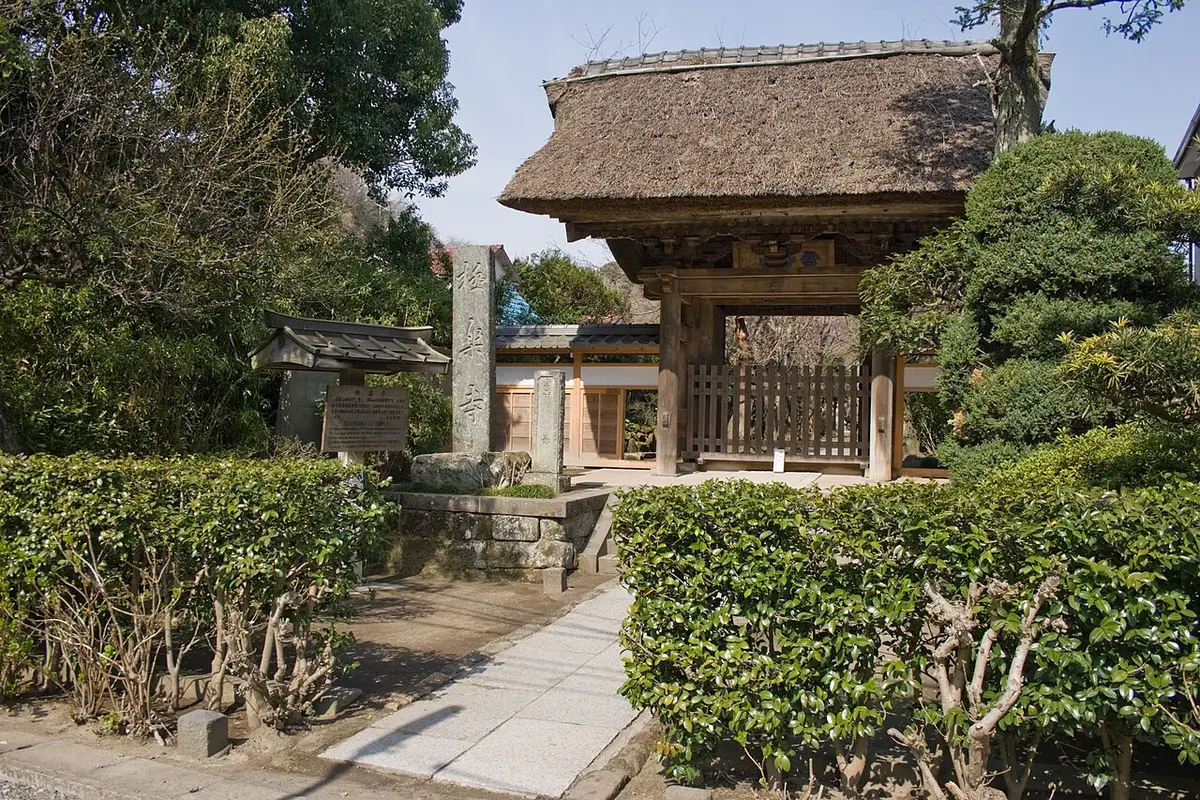
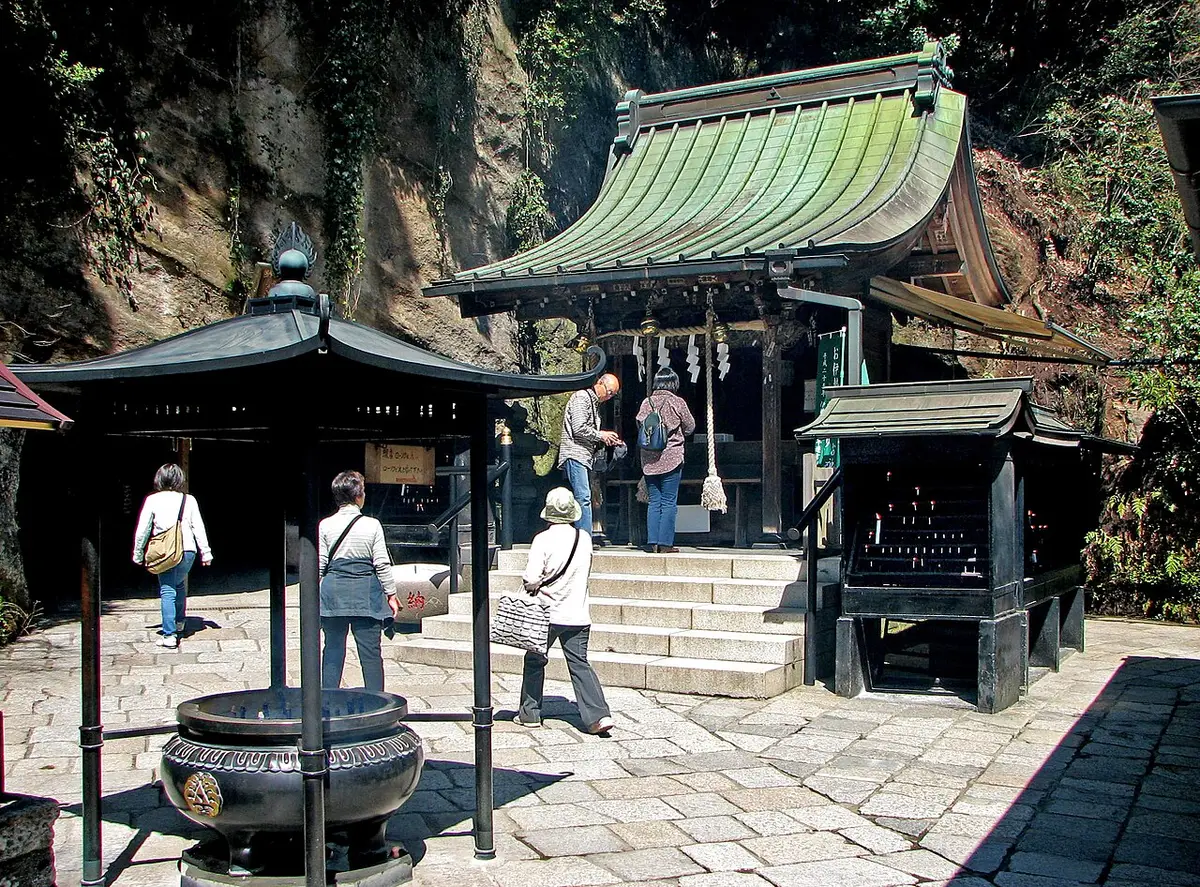
Zeniarai Benten, the cave shrine where people wash coins in spring water (the shrine dates its founding to 1185), is about 21 minutes on foot from Kamakura Station up a valley west of the center. It is not a hydrangea garden, but the hill around it is a good mid-season detour. On June 16, 2026, the tourism association reported hydrangeas at their best at Sasuke Inari Shrine, about 6 minutes on foot from Zeniarai, along the path in front of the Yoritomo statue in Genjiyama Park, and on the hydrangea lane at Kuzuharaoka Shrine next to the park. The shrine is open 8:00 to 16:30 (arrive by 16:00) and asks for an offering instead of a fee. It suits a second hydrangea day or a walk over the hill toward the Daibutsu hiking trail.
Fee offeringHours 8:00-16:30, arrive by 16:00From Kamakura Stn about 21 min on footMapOfficial site
A hydrangea day in Kamakura: weekday and weekend order
Both routes cover Meigetsu-in, Hasedera and the Great Buddha and end near a station. The difference is which end of town gets your opening hour. Walking times are from the temples’ own pages where they state one, otherwise “about N minutes on foot” along OpenStreetMap paths. The day planner builds a version for your date, and the Kamakura map shows every stop.
Weekday: Kita-Kamakura first
- 8:30 Meigetsu-in. Take an early JR Yokosuka Line train to Kita-Kamakura and walk 10 minutes to be at the gate when it opens. Allow about an hour, plus the rear garden if it is open.
- About 9:45 Tokeiji. About 12 minutes on foot from Meigetsu-in, back toward the station. No photos, so it goes quickly or slowly as you like.
- About 10:30 Engakuji. About 9 minutes on foot from Tokeiji, opposite the station.
- About 11:30 to Hase. JR Kita-Kamakura to Kamakura (3 minutes, ¥155), then the Enoden to Hase (4 minutes, ¥200). Trains leave Kamakura about every 14 minutes.
- Midday Hasedera. Book a window around noon on the Tuesday before; on weekdays you may also get a day ticket, but numbers are limited.
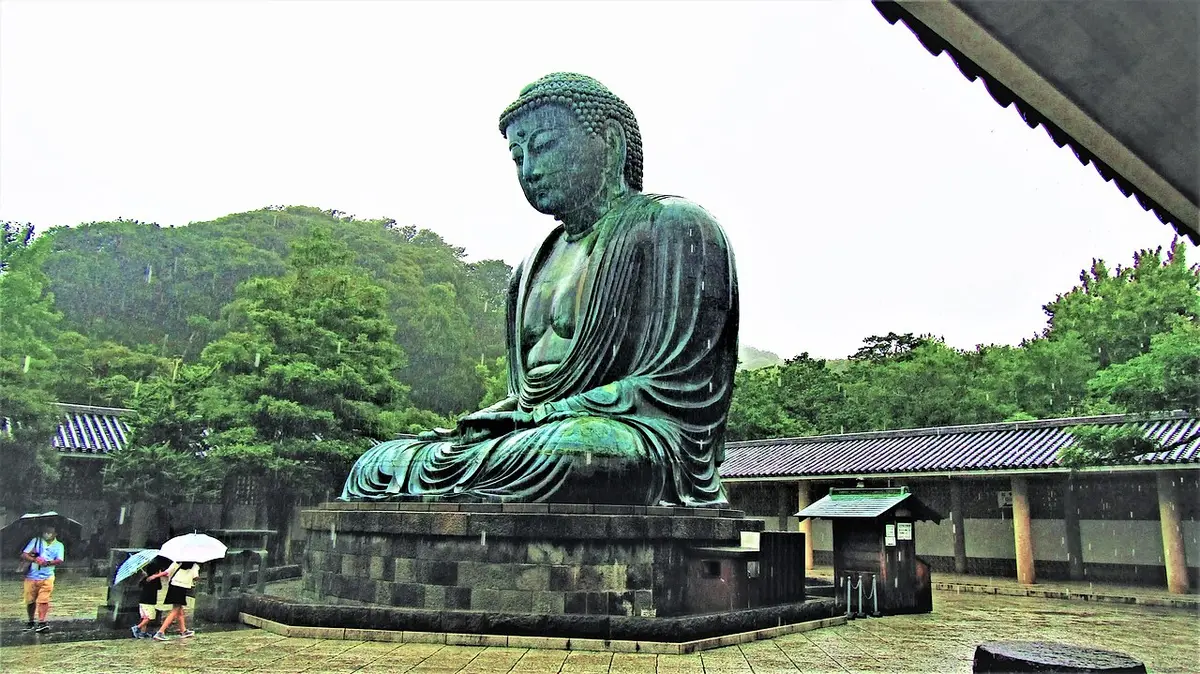
- Great Buddha. Kotoku-in is 5 minutes on foot from Hasedera; the Great Buddha guide has the details. Lunch in Hase (ideas in the food guide).
- Afternoon: Goryo Shrine, Jojuin, Gokurakuji. Walk west from Hase past Goryo Shrine, or take the Enoden one stop to Gokurakuji (1 minute, ¥200). Finish at Gokurakuji before 16:30 and ride back to Kamakura (7 minutes, ¥220).
Weekend: Hase first
- 8:00 Hasedera with the first window. Book the 8:00 to 9:00 window at 10:00 on the Tuesday before. Take the Enoden from Kamakura to Hase and walk 5 minutes; be at the gate a little before 8:00.
- About 9:30 Great Buddha. 5 minutes on foot; Kotoku-in opens at 8:00, so it is already open.
- About 10:30 Goryo Shrine, Jojuin and Gokurakuji. Jojuin is about 7 minutes on foot from Hase Station; Gokurakuji opens at 9:00.
- Late morning to Kita-Kamakura. Enoden Gokurakuji to Kamakura (7 minutes, ¥220), JR to Kita-Kamakura (3 minutes, ¥155). Lunch near the station.
- Early afternoon Engakuji, then Tokeiji. Both close at 16:30 and 16:00, so see them before Meigetsu-in.
- About 14:30 Meigetsu-in. Last entry was 16:30 in June 2026. Check the Kamakura live crowd map before you walk over.
How early to arrive
Meigetsu-in: at opening. The approach is narrow and everyone enters through the same gate, so the first hour is the calmest. On June 11, 2026, the tourism association described the main approach as busy at peak and the rear garden as comparatively quiet, which is a reason to pay for the rear garden on a crowded day.
Hasedera: at your window, not earlier. You cannot enter the path before your booked window starts, so arriving 30 minutes early only helps if you want time in the lower precinct first. The 8:00 window is the only one that starts when the temple opens.
Weekdays beat weekends. June is one of Kamakura’s busiest months: the city counted 1,676,678 visits in June 2025, more than any month except January. We suggest a Monday to Thursday in the second or third week of June as the best balance of bloom and crowds; the calendar has the bloom window.
Rain is fine. The tourism association’s own line is that rain makes hydrangeas brighter, and Hasedera’s June posts show the path in the rain. The steps get slippery.
Where to stay the night before
Opening hours are the whole game in June, and a night in Kamakura puts you at a temple gate at 8:00 without a 6 a.m. train. Stay at the end of town you want to start at. The where to stay in Kamakura guide compares the areas in more detail.
- Near Kita-Kamakura: Kita-Kamakura 520 is beside Kita-Kamakura Station in Yamanouchi, so Engakuji is across the road and Meigetsu-in a 10-minute walk. It suits the weekday route.
- In Hase: BRB Kamakura Hase is a small property in a residential street of Hase, within walking distance of Hasedera and the Great Buddha. It suits the weekend route with the 8:00 window.
- In Hase, traditional house: Ushio Guesthouse is a renovated older house about six minutes on foot from Hasedera.
Hotels around Kamakura Station are the middle option: Kita-Kamakura is one JR stop away and Hase four minutes on the Enoden.
Tours in hydrangea season
A tour solves two problems in June: someone else watches the clock, and on the guided private options someone else plans around the ticket windows. None of these include the Hasedera hydrangea ticket unless the listing says so, and admission fees are usually extra.
- From Tokyo, both big temples: the one-day flower viewing tour covers Meigetsu-in, Hasedera, Tsurugaoka Hachimangu and Enoshima with transport from Tokyo. Hasedera’s hydrangea ticket is not included.
- Hase at opening time: the early-bird morning tour is a five-to-six-hour walk with Hasedera, the Great Buddha, Hokokuji and Tsurugaoka, eight people at most, with an option to start in Tokyo.
- Kita-Kamakura to Hase on foot: the half-day Zen temples and Great Buddha walk follows the same direction as the weekday route.
- Your own pace: a half-day private tour with a licensed guide lets you pick the stops and the order; transport between sites is by train or taxi.
The Kamakura tours guide compares more options outside the season.
Practical: getting there, cost and what to bring
Getting there. From Tokyo Station the JR Yokosuka Line runs to Kita-Kamakura in 53 minutes (¥902 by IC card) and Kamakura in 56 minutes (¥1,034); check your train on JR East’s route search. Enoden fares are on the Enoden fare page. For Hase, change at Kamakura to the Enoden. Shinjuku, Shinagawa and Yokohama all have direct trains; see how to get to Kamakura and the day trip from Tokyo guide. If you ride the Enoden four or more times, the ¥800 Noriorikun day pass can pay off; the Freepass page does the maths.
Cost. The weekday route above, from Tokyo and back, comes to ¥4,711 per adult for trains, Engakuji, Meigetsu-in, Hasedera with the hydrangea ticket and the Great Buddha (Kotoku-in is ¥300). With Meigetsu-in’s rear garden it is ¥5,211. Food comes on top; the trip cost calculator adds it for your group.
Bring. Shoes with grip for wet stone steps, a small umbrella that closes easily in narrow paths, cash for offerings at Jojuin, Gokurakuji and Zeniarai, and a charged phone with your QR ticket if you booked Hasedera online.
Photos. Tokeiji, Goryo Shrine’s grounds and the inside of Jojuin’s gate are photo-free. Hasedera banned tripods and monopods for its autumn evening opening, and narrow hydrangea paths are no place for them in June either.
After the season. The temples prune in July, and Meigetsu-in closes while it prunes. In 2025 Hasedera started pruning on July 1, and in 2026 it finished on July 6. If you arrive in the first week of July, expect cut-back shrubs. For the rest of the year, see things to do in Kamakura or the one-day itinerary, and for a second day add Enoshima.
Questions people ask
When is hydrangea season in Kamakura in 2027?
Plan on early to late June. The Yokohama observatory's first hydrangea bloom is most likely around June 11, 2027, within June 3 to June 17. First bloom is not peak: in 2023 to 2026 the week of June 10 to June 17 fell inside Hasedera's peak every year, and in 2026 Meigetsu-in was already at its best on May 28.
Do you need a ticket for the hydrangea path at Hasedera?
Yes, during the paid period, which runs from about half bloom until the peak has passed. The hydrangea ticket costs ¥500 for anyone of elementary school age and up, on top of the ¥400 admission. You can book a 60-minute entry window online (booking opened on Tuesdays at 10:00 in 2026) or buy a day ticket at the path entrance while they last.
Meigetsu-in or Hasedera: which is better for hydrangeas?
They are different. Meigetsu-in is a narrow approach lined with about 2,500 mostly blue shrubs in a quiet Kita-Kamakura valley, plus the round window. Hasedera has more than 40 varieties on a hillside path with a view over Yuigahama and the sea, and a timed ticket. With one day, see both: one at opening time, the other with a booked slot.
How early should you arrive at Meigetsu-in in June?
Be at the gate when it opens. In June 2026 Meigetsu-in opened at 8:30 instead of 9:00. Kita-Kamakura Station is a 10-minute walk away and 53 minutes from Tokyo Station on the JR Yokosuka Line, so an early train from Tokyo puts you at the front before tour groups and day-trippers arrive.
Is it worth seeing Kamakura's hydrangeas in the rain?
Yes. June is the rainy season and the temples plan for it; Hasedera's own bloom notes show the path in the rain. Wet stone steps are slippery, so wear shoes with grip, and note that Hasedera's hydrangea path has about 130 steps with no slope.
Read next


Sources (19)
- Hasedera (official): admission and hours
- Hasedera (official): 2026 hydrangea path notice (archived copy)
- Hasedera press release, 6 May 2026 (PR TIMES): hydrangea ticket booking
- Hasedera flower posts 2023 to 2026
- Kamakura City Tourism Association: 2026 hydrangea reports
- Kamakura City Tourism Association: Meigetsu-in
- Kamakura City Tourism Association: Jojuin
- Kamakura City Tourism Association: Gokurakuji
- Kamakura City Tourism Association: Goryo Shrine
- Kamakura City Tourism Association: Zeniarai Benzaiten
- Engakuji (official): hours and fees
- Tokeiji (official): hours and photography rule
- Gokurakuji (official)
- Jojuin (official)
- Kotoku-in (official): hours and fees
- Japan Meteorological Agency: phenology records (Yokohama)
- JR East Real-Time Route Search (fares and times)
- Enoden: fares between stations
- OpenStreetMap walking routes (OSRM foot profile)